Jetocaris
PassivelargeOverview
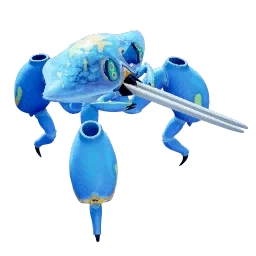
The Jetocaris (*Tripod phrontiscaris*) is a large passive crustacean found at depths of 50–350m in Subnautica 2. With only 100 HP — the lowest among all large creatures — and no attack capability, the Jetocaris is one of the safest fauna to encounter and one of the most rewarding to observe.
Behavior & Details
The Jetocaris is biologically unique on Proteus and unmatched on Earth: no three-legged organisms exist in terrestrial evolution due to the early establishment of bilateral symmetry. Its tripod body plan likely emerged from the fusion of six ancestral legs into three, with each leg housing a valved thruster evolved from gill tissue. These leg jets allow the Jetocaris to hover and swim with efficiency that simulations confirm improves with the fused-leg design.
Two long, flexible feeding tongues (radulae evolved from food-handling maxillipeds) search for food on the seafloor while small forelimbs groom these sensitive appendages. The tongues are capable of regeneration, a useful trait given that something in the seabed regularly bites them — hinting at unseen predators in the Jetocaris's habitat.
Tips & Strategy
The Jetocaris is completely passive with no attacks — ideal for new players to practice scanning technique. At 100 HP it is fragile, so avoid accidentally harming one while learning combat controls nearby.
With a 6,000-unit sight range, the Jetocaris will notice you from far away but will not flee or attack. Use this to your advantage by observing its behavior undisturbed from any distance.
Watch for Jetocaris family groups carrying juveniles — the parenting behavior is unique among Subnautica 2 fauna and the adopted young (identifiable through spectrogenetic analysis) suggest complex social structures.
Jetocaris feeding tongues regenerate after damage, which means their habitat likely contains hidden predators that bite the tongues. Scan the seafloor carefully around Jetocaris groups for other fauna you might have missed.
Found across a wide 50–350m depth range, the Jetocaris is one of the most commonly encountered large creatures. Their presence is a good indicator of a relatively safe area for exploration and base building.
PDA Entry
Spawn Locations (15)
Subnautica 2 Gameplay
Jetocaris
passive creature- Health
- 100 HP
- Attitude
- Passive
- Depth
- 50–350m
- Sight Range
- 60m