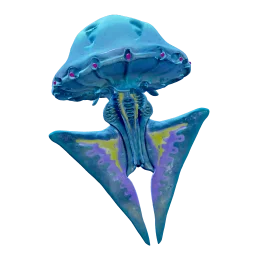
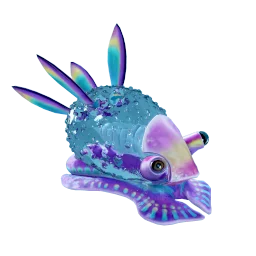
Hoverthorn

Passive
Attitude
Passive
Depth
100–500m
Food
+15
Water
-5

Overview

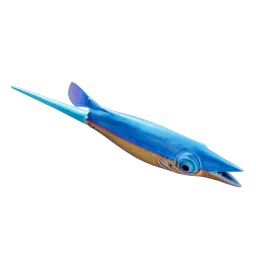
*Monopter astrapakantha*, the one-finned lightning thorn. A small fish that has discarded fins in favor of a living magnetohydrodynamic thruster.


Habitat


Tips & Strategy

Monopter: Fish are a common body plan across alien worlds, but they usually evolve fins or wings for propulsion. The hover thorn has just a single fin — a tail rudder at the base of the spinal braid. Spiracles behind the double eyes draw water for an internal gill.

Doubled eye: The hoverthorn's large primary eye is duplicated by a small secondary eye which contains columns of electro-active jelly. The hoverthorn can effectively see electromagnetic fields. The second eye was created by a duplication in the hoverthorn's HOLOX genes, which organize the thorn's body plan. A viral gene sequence copying itself throughout the hoverthorn's genome apparently copy-pasted the eye 'blueprint' several million years ago.

Hoverthorn: The hoverthorn's most incredible trait is its charge crystal, a mineralized swim bladder which fills the lower body cavity and protrudes from what was once a thruster orifice. A mineral Campbell matrix in the crystal organizes electric charge. When a portion of the crystal is charged, it polarizes and attracts surrounding seawater. Moving the charge along the crystal creates currents in the seawater — allowing the hoverthorn to generate and ride its own water currents.

Mating behavior: Hoverthorns joust with their charge crystals, approaching each other tail-first. As the crystals approach, their fields interact, and the weaker or less skilled hoverthorn will lose control. Both male and female hoverfish use this to either drive away or select fit mates. Assessment: fascinating.


PDA Entry

PDA // Databank
*Monopter astrapakantha*, the one-finned lightning thorn. A small fish that has discarded fins in favor of a living magnetohydrodynamic thruster. 1. Monopter Fish are a common body plan across alien worlds, but they usually evolve fins or wings for propulsion. The hover thorn has just a single fin — a tail rudder at the base of the spinal braid. Spiracles behind the double eyes draw water for an internal gill. 2. Doubled eye The hoverthorn's large primary eye is duplicated by a small secondary eye which contains columns of electro-active jelly. The hoverthorn can effectively see electromagnetic fields. The second eye was created by a duplication in the hoverthorn's HOLOX genes, which organize the thorn's body plan. A viral gene sequence copying itself throughout the hoverthorn's genome apparently copy-pasted the eye 'blueprint' several million years ago. 3. Hoverthorn The hoverthorn's most incredible trait is its charge crystal, a mineralized swim bladder which fills the lower body cavity and protrudes from what was once a thruster orifice. A mineral Campbell matrix in the crystal organizes electric charge. When a portion of the crystal is charged, it polarizes and attracts surrounding seawater. Moving the charge along the crystal creates currents in the seawater — allowing the hoverthorn to generate and ride its own water currents. 4. Mating behavior Hoverthorns joust with their charge crystals, approaching each other tail-first. As the crystals approach, their fields interact, and the weaker or less skilled hoverthorn will lose control. Both male and female hoverfish use this to either drive away or select fit mates. Assessment: fascinating.

Spawn Locations (50)

Loading map...

Subnautica 2 Gameplay

Hoverthorn icon

Hoverthorn

passive creature
Stats
Attitude
Passive
Depth
100–500m
Food Value
+15
Water Value
-5
View on Map

Frequently Asked Questions

Where can I find the Hoverthorn in Subnautica 2?
The Hoverthorn can be found in Observatory Ruins at depths of 100–500m. There are 50 known spawn locations mapped on our interactive map.