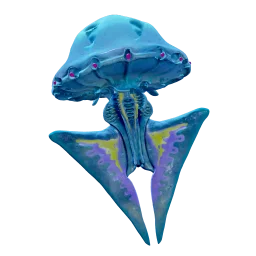
Surge Jelly
DefensivelargeherbivoreOverview
The Surge Jelly (*Staurobrachia capacitor*) is a large defensive creature found in the Observatory Ruins across a wide depth range of 0–350m in Subnautica 2. Unlike colonial Earth jellies such as the Portuguese man-o'-war, the Surge Jelly is a single complex animal with tissue specialization far exceeding anything found in terrestrial cnidarians.
Habitat
Behavior & Details
The Surge Jelly's primary defense is a powerful electric discharge delivered through two rigid fins containing wirelike electrocytes — structures evolved from ancestral tentacles. These organs generate between 400 and 1,000 volts at 1 ampere, which is more than sufficient to kill a human. Despite this lethal capability and a classified herbivore diet, the Surge Jelly uses its electrical system defensively rather than for active hunting.
The creature's internal anatomy is surprisingly complex: an outer bell ringed with sense organs (rhopalia) coordinates swimming through a nerve net, while a retained stalk — a remnant of its growth from a clonal stack — draws in nutrients for the visible gut structure. Traces of radioactivity, high-temperature waxes, and sulfuric acid in its tissues indicate prior contact with hydrothermal vents, suggesting the Surge Jelly originates from much deeper water than its current 0–350m patrol range.
Tips & Strategy
The Surge Jelly outputs 400–1,000 volts at 1 ampere — lethal to unprotected divers. Maintain at least 10 meters of clearance when swimming near one. The electric discharge has no visible warning animation beyond fin positioning.
Surge Jellies are defensive, not aggressive. They will not chase you, but their wide 0–350m depth range means you can encounter them at almost any depth in the Observatory Ruins. Always scan your vertical surroundings.
Electrical equipment may behave erratically near Surge Jellies. If your scanner or base systems glitch in the Observatory Ruins, check for nearby Surge Jellies before assuming hardware failure.
Surge Jellies that cluster together communicate via electric fields. Groups are more electrically active than isolated individuals — give clustered Surge Jellies wider clearance than solitary ones.
Traces of hydrothermal chemicals in their tissues suggest Surge Jellies migrate from deep ocean vents. Encountering them in unusually shallow water may indicate nearby volcanic or thermal activity worth investigating.