Coral Crab
AggressivelargeOverview
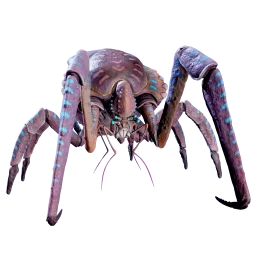
The Coral Crab (*Ostrakonskelos anaktoraphore*) is an enormous aggressive crustacean found in the Coral Gardens biome at shallow depths of 0–50m. With 1,000 HP and a 6-second scan duration — one of the longest in the game — this large creature demands patience and careful positioning to study.
Habitat
Behavior & Details
The Coral Crab wears a living coral dome cut from its holdfast, providing camouflage that makes it easy to mistake for part of the reef. It rakes the seafloor with its forelimbs and collects food with long, soft maxillipeds around its mouth. Despite its aggressive classification, its PDA assessment notes it "likely fears you more than you fear it" — its heavy defenses evolved against a natural predator powerful enough to shuck it from its dome.
With intelligence comparable to a gorilla, Coral Crabs exhibit complex social behaviors. They communicate by drumming on the seafloor and clack their claws when agitated. Some Earth crabs seek partners through "handholding" behavior prior to molting, and researchers hope to observe similar behavior on Proteus.
Tips & Strategy
At 6 seconds, the Coral Crab has one of the longest scan times in Subnautica 2. Find a safe angle behind the coral dome where the crab's eyes cannot track you, and commit to the full scan duration without interruption.
Listen for seafloor drumming — Coral Crabs signal each other this way. Drumming means at least one crab is nearby. Claw-clacking indicates agitation, so back off immediately if you hear it.
Coral Crabs are well-camouflaged in the Coral Gardens at 0–50m depth. Before approaching what looks like a coral dome, watch for movement in the forelimbs raking the seafloor — that reveals a living crab.
The crab must molt to grow, making it temporarily vulnerable during that period. If you spot a motionless crab with a pale, soft-looking shell, it may be mid-molt — scan from a safe distance without disturbing it.
Despite 1,000 HP and aggressive classification, the Coral Crab is primarily defensive. Slow, deliberate movement reduces the chance of triggering a defensive response. Sudden movements or loud vehicles are more likely to provoke claw-clacking and charges.
PDA Entry
Spawn Locations (50)
Subnautica 2 Gameplay
Coral Crab
aggressive creature- Health
- 1000 HP
- Attitude
- Aggressive
- Depth
- 0–50m
- Scan Time
- 6s